When BIM Coordination Fails: A Post-Mortem Cost Analysis
BIM coordination failures do not announce themselves during the coordination process. They announce themselves on site — when the installing trade discovers that the coordinated model does not match reality, when the ductwork does not fit in the allocated space, or when the cable tray clashes with the pipework that was supposed to be resolved three months ago.
BIM coordination failures do not announce themselves during the coordination process. They announce themselves on site — when the installing trade discovers that the coordinated model does not match reality, when the ductwork does not fit in the allocated space, or when the cable tray clashes with the pipework that was supposed to be resolved three months ago.
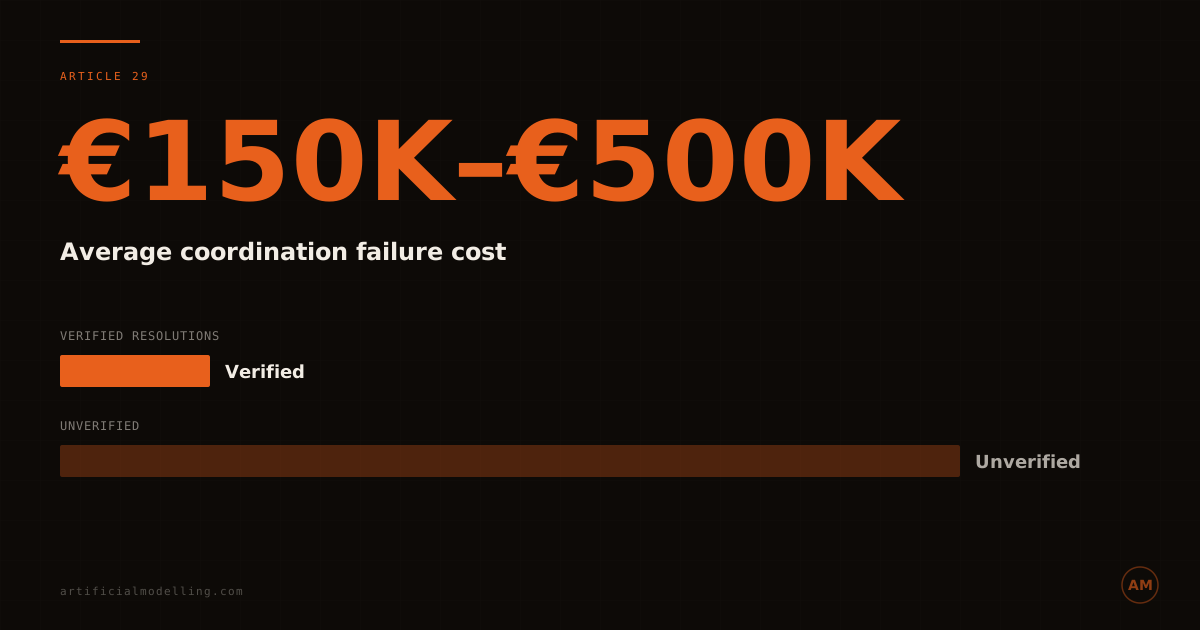
A coordination failure on a medium-to-large commercial project typically costs €150,000–€500,000 in direct and indirect consequences. This article examines the anatomy of a coordination failure — what goes wrong, where the costs accumulate, and what the post-mortem reveals about how it could have been prevented.
The Anatomy of Failure
Coordination failures follow a predictable pattern. The root cause is established during the coordination phase — 3 to 9 months before it manifests on site. The failure propagates through procurement, fabrication, and delivery before finally becoming visible during installation.
Phase 1: The coordination gap. A clash between a DN300 chilled water pipe and a 600mm×400mm supply air duct in a ceiling void is identified in the clash report. The proposed resolution — lower the duct by 100mm — is accepted by the design team verbally but not implemented in the model. The coordination team does not verify the implementation because the programme is compressed. The clash is marked as "resolved" in the coordination log.
Phase 2: The silent propagation. Construction drawings are issued from the unrevised model. The duct fabrication order is placed based on the original routing — 100mm higher than the accepted resolution. The pipe fabrication order is placed based on the coordinated position. Both orders are correct according to their respective source documents, but the source documents are inconsistent.
Phase 3: The site discovery. The mechanical subcontractor installs the ductwork at the fabricated dimensions. The plumbing subcontractor arrives to install the chilled water pipework and finds the duct occupying the space where the pipe should be. The site team calls the coordinator. The coordinator reviews the model and finds the resolution was never implemented.
Phase 4: The cascade. Resolving the clash on site requires one of three options: cut and modify the installed ductwork (€8,000–€15,000), reroute the pipework around the duct (€5,000–€12,000), or lower the ceiling to accommodate both (€3,000–€8,000 plus architectural impact). The chosen solution delays the installation programme by 3–5 days in the affected zone, pushing subsequent trades back and potentially affecting the critical path.
The Cost Stack
A single significant coordination failure generates costs across five categories:
| Cost Category | Typical Range (€) |
|---|---|
| Direct rework (cutting, removing, re-fabricating, reinstalling) | €5,000–€25,000 |
| Material waste (removed components, unused fabrications) | €2,000–€10,000 |
| Programme delay (per week of impact) | €25,000–€100,000 |
| Management overhead (meetings, RFIs, revised drawings) | €3,000–€8,000 |
| Subcontractor claims and disruption | €5,000–€50,000 |
| Total per failure | €40,000–€193,000 |
A project with 5–10 significant coordination failures faces cumulative costs of €200,000–€1,930,000. Most projects with failed coordination experience 3–7 significant failures plus 20–40 minor failures.
FAQ
What is the average cost of a BIM coordination failure?
A single significant coordination failure costs €40,000–€193,000 when all consequences are included — direct rework, material waste, programme delay, management overhead, and subcontractor claims. A project with multiple failures faces cumulative costs of €200,000–€500,000+.
What causes most coordination failures?
The most common root cause is unverified clash resolutions — clashes that are accepted verbally or on paper but never implemented in the model and never checked before construction drawings are issued.
Artificial Modelling verifies every resolution in the model before sign-off. Fixed-price. Zero unverified resolutions. Get a proposal →