Sustainability and MEP Coordination: The Cost of Missing Your BREEAM or LEED Target
Sustainability certification — BREEAM in the UK and Ireland, LEED in international markets — has transitioned from a voluntary aspiration to a commercial requirement on most institutional-grade construction projects. Investors, tenants, and planning authorities increasingly require specific certification levels, and achieving those levels depends directly on MEP system performance.
Sustainability certification — BREEAM in the UK and Ireland, LEED in international markets — has transitioned from a voluntary aspiration to a commercial requirement on most institutional-grade construction projects. Investors, tenants, and planning authorities increasingly require specific certification levels, and achieving those levels depends directly on MEP system performance.
MEP coordination affects sustainability certification through three credit categories: energy performance (the largest single credit block), indoor environmental quality (ventilation effectiveness, thermal comfort), and construction waste reduction (material efficiency, rework minimisation). Poor coordination can cause a project to miss its target certification level — a failure with measurable financial consequences.
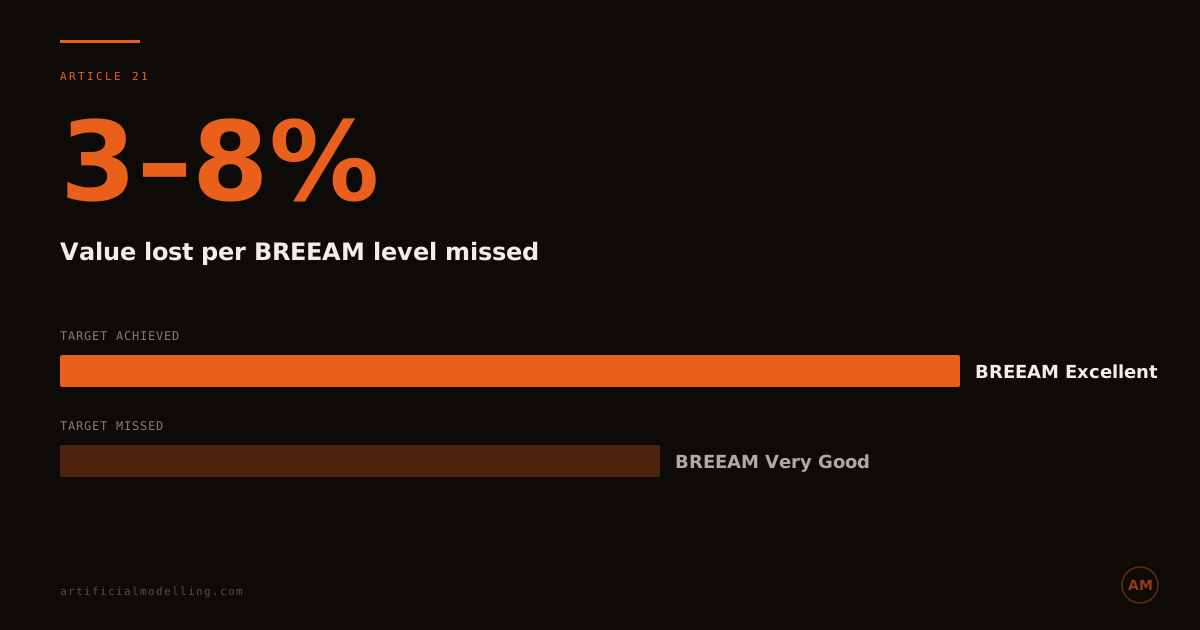
Missing a BREEAM rating by one level — for example, achieving "Very Good" instead of "Excellent" — reduces the property's market value by an estimated 3–8% (RICS Sustainability and Commercial Property Valuation, 2023). On a £50 million commercial building, a one-level rating drop represents £1.5–£4 million in lost property value. The coordination effort required to protect those credits costs a fraction of that amount.
How MEP Coordination Affects Sustainability Credits
Energy performance credits depend on the installed MEP systems operating at their design efficiency. Coordination failures that introduce additional pressure drops (extra bends in ductwork, undersized openings in risers), non-optimal equipment locations (reduced free-cooling potential from poor plant positioning), or unplanned thermal bridges (service penetrations through insulated envelopes) all reduce energy performance below the design intent.
A ductwork system coordinated with three additional 90-degree bends per major run — because coordination was done too late to optimise routes — increases fan energy consumption by 8–15%. This may be the difference between meeting and missing the energy credit threshold.
Indoor air quality credits require ventilation systems to deliver design airflows to occupied spaces with acceptable noise levels. Coordination failures that compromise duct cross-sections (flattened ducts to fit tight spaces), create turbulent airflow (abrupt transitions, uncoordinated grille positions), or produce excessive noise (ductwork running through acoustically sensitive zones without attenuation) directly reduce indoor air quality performance.
Construction waste credits are affected by rework. Every rework incident generates construction waste — removed ductwork, cut-off pipework, discarded cable tray sections, replaced insulation. Rework is a significant contributor to construction waste on projects without effective coordination — every rework incident generates removed ductwork, cut-off pipework, discarded cable tray sections, and replaced insulation. Reducing rework through BIM coordination directly improves the construction waste score.
The Financial Impact
The cost of missing a sustainability target manifests in three ways.
Property value reduction: Missing a BREEAM rating by one level reduces market value by 3–8%. On institutional-grade assets, this represents millions in lost value.
Tenant premium loss: BREEAM "Excellent" and "Outstanding" buildings command 4–12% rental premiums over "Good" and "Very Good" buildings (JLL Sustainability Research). Over a 10-year lease period, the cumulative lost premium on a 10,000 sqm building at £40/sqm exceeds £400,000.
Remediation cost: Achieving the target rating post-construction — through equipment upgrades, additional insulation, or system modifications — typically costs 3–5× the amount that would have been required to achieve it during design and coordination.
FAQ
How does BIM coordination affect BREEAM ratings?
BIM coordination affects BREEAM ratings through energy performance credits (optimised MEP routing reduces system energy consumption), indoor air quality credits (properly coordinated ventilation delivers design airflows), and construction waste credits (reduced rework minimises waste). The coordination effort required to protect these credits costs a fraction of the value lost by missing a rating level.
What is the cost of missing a BREEAM rating by one level?
Missing a BREEAM rating by one level reduces property value by an estimated 3–8%. On a £50 million building, this represents £1.5–£4 million. Additionally, tenant rental premiums for higher-rated buildings are 4–12% above standard ratings.
Artificial Modelling delivers MEP coordination that protects your sustainability credits. Fixed-price. Performance-focused. Start a conversation →