The Subcontractor's Guide to BIM Coordination: What Poor Models Cost You
This article is written for MEP subcontractors — mechanical, electrical, plumbing, and fire protection contractors — who submit BIM models for coordination on construction projects. The coordination process depends on the quality of your model submissions. When your models are incomplete, inaccurate, or submitted late, the cost is not absorbed by the coordination team.
This article is written for MEP subcontractors — mechanical, electrical, plumbing, and fire protection contractors — who submit BIM models for coordination on construction projects. The coordination process depends on the quality of your model submissions. When your models are incomplete, inaccurate, or submitted late, the cost is not absorbed by the coordination team. It flows back to you — through back-charges, rejected submissions, schedule compression, and site rework that becomes your contractual responsibility.
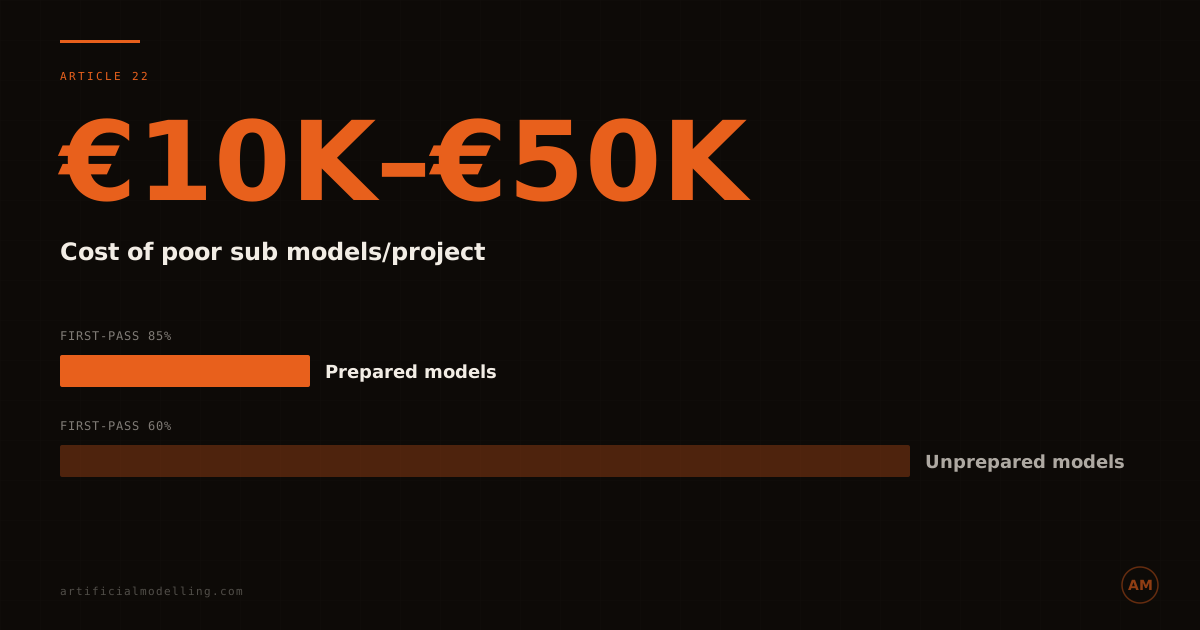
The cost of submitting poor-quality models for coordination ranges from €10,000 to €50,000 per project for a typical MEP subcontractor. This cost is almost entirely avoidable.
What Poor Model Submissions Cost You
Back-charges for re-coordination are the most direct cost. When a subcontractor submits a model that requires the coordination team to spend additional hours cleaning up element classifications, correcting system assignments, or rebuilding poorly modelled components, those hours are back-charged. At coordinator rates of €60–€100/hr (PowerKH, 2025 — US market data), 50–100 hours of additional coordination effort due to poor model quality costs €3,000–€10,000 per project.
Rejected submissions create revision cycles that consume your own modelling team's time. Each rejection requires review of the coordinator's comments, model revision, re-export, and re-submission. A subcontractor whose model is rejected 3–5 times before acceptance spends 30–60 hours on revisions — €2,400–€6,000 in internal modelling cost. Compare this to a subcontractor who achieves first-pass acceptance and spends zero hours on revisions.
Schedule compression is the indirect cost. When your model submissions are late, the coordination programme compresses. The coordination team has less time to identify and resolve clashes, which means more clashes are discovered during installation. Those installation-stage clashes are your problem — you are the trade installing the services. Each site clash that could have been caught in coordination costs €2,000–€10,000 to resolve in the field.
Contractual liability is the long-tail cost. Most modern construction contracts assign rework responsibility to the subcontractor whose work caused the clash. If your ductwork conflicts with another trade's pipework, and the clash was caused by your model being inaccurate, the rework cost — and the programme delay claim — flows to you.
What Your Coordinator Needs From Your Model
A coordination-ready model meets five criteria.
Correct element classification. Every element in your model should have the correct system type, system classification, and family category. A supply air duct classified as "undefined" cannot be properly checked against return air ducts or exhaust ducts. Correct classification enables automated clash detection rules and prevents false positives that waste everyone's time.
Accurate sizing. Model your services at their actual installed dimensions, including insulation thickness, hanger clearances, and accessory space (valves, dampers, filters). A pipe modelled at nominal bore without insulation will pass clash detection — but when the insulated pipe is installed, it clashes with everything within the insulation thickness.
Complete coverage. Include all services in your scope — not just the main runs. Branch connections, drops, taps, isolation valves, access points, and connection points to other trades are where most clashes occur. A model that shows only trunk routes misses 60–70% of the coordination-relevant information.
Current revision. Submit your model at the revision that matches the current coordination cycle. Submitting a model that is two revisions behind means the coordination team is checking your outdated design against everyone else's current design — a waste of time that produces meaningless results.
Shared coordinates. Your model must be positioned correctly relative to the project origin point. A model that is 5 metres offset from the coordination model's origin will show false clashes at every location. Coordinate system alignment is a 5-minute check that prevents hours of false positive investigation.
The First-Pass Benchmark
The industry average for first-pass submission approval is approximately 60–65%. Subcontractors who consistently achieve 80–85% first-pass rates spend significantly less on revision cycles and receive fewer back-charges. The difference between 65% and 85% first-pass approval on a project with 100 drawing submissions is 20 fewer rejections — saving 80–120 hours of revision effort (€6,400–€12,000) and an equivalent amount in coordinator review time.
FAQ
How much does poor model quality cost a subcontractor?
Submitting poor-quality BIM models for coordination costs subcontractors €10,000–€50,000 per project through back-charges, revision cycles, schedule compression, and site rework responsibility. The majority of this cost is avoidable through proper model preparation.
What is the most common model submission mistake?
Submitting models with incorrect or missing system classifications is the most common mistake. It prevents automated clash detection rules from functioning correctly and generates false positives that waste coordination time.
What first-pass approval rate should a subcontractor target?
Target 80–85% first-pass approval. The industry average is 60–65%. Every 10% improvement in first-pass rate saves approximately 30–50 hours of revision effort per project.
Artificial Modelling works with subcontractors to streamline model submissions and reduce coordination cycles. Fixed-price coordination. Fewer revisions. Talk to us →