The Real Timeline of BIM Coordination: What Compressed Programmes Cost
BIM coordination takes as long as it takes. This is not a platitude — it is a statement of engineering reality. The coordination programme is driven by the number of discipline models, the number of coordination zones, the complexity of the MEP systems, and the responsiveness of the design teams. Compressing the programme beyond its natural duration does not speed up the project.
BIM coordination takes as long as it takes. This is not a platitude — it is a statement of engineering reality. The coordination programme is driven by the number of discipline models, the number of coordination zones, the complexity of the MEP systems, and the responsiveness of the design teams. Compressing the programme beyond its natural duration does not speed up the project. It shifts cost from the coordination phase to the construction phase — where it multiplies.
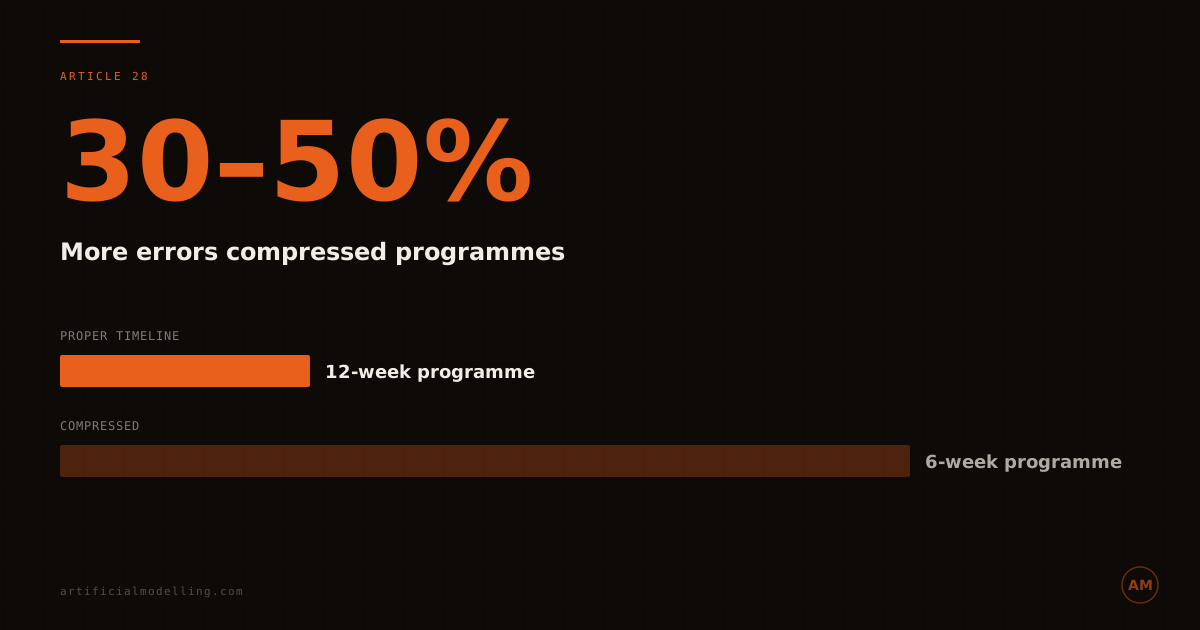
A coordination programme that should take 12 weeks but is compressed to 6 weeks produces measurably lower-quality output. Industry experience indicates that programme compression of 40% or more increases coordination errors by 30–50%, which translates to 30–50% more site clashes discovered during installation. At an average resolution cost of €5,000–€15,000 per significant clash, 10–20 additional clashes cost €50,000–€300,000 in construction-phase rework.
The coordination fee saving from a compressed programme is typically €20,000–€40,000. The additional rework cost is 2–8× higher.
What a Realistic Timeline Looks Like
For a 20,000 sqm commercial building with standard MEP complexity (office, retail, or education), the coordination timeline breaks down as follows:
| Phase | Duration | Activities |
|---|---|---|
| Model receipt and audit | 1–2 weeks | Receive all discipline models, verify currency, check shared coordinates, audit element classification |
| First coordination pass | 3–4 weeks | Federate models, run initial clash detection, classify clashes, propose resolutions for critical items |
| Design team response | 2–3 weeks | Design teams review clash reports, accept/reject/modify proposed resolutions, issue revised models |
| Second coordination pass | 2–3 weeks | Re-federate revised models, verify resolutions, run updated detection, address remaining items |
| Final coordination and sign-off | 1–2 weeks | Issue final coordination report, confirm all critical clashes resolved, produce construction-ready deliverables |
| Total | 9–14 weeks |
For complex facilities — data centres, hospitals, pharmaceutical plants — add 4–8 weeks. The additional time reflects higher service density, stricter compliance requirements, and more discipline interfaces.
What Compression Actually Costs
When the 12-week programme is compressed to 6 weeks, the following happens:
Clash classification is skipped. Instead of sorting 2,000 clash results into critical, significant, and minor categories, the coordination team issues the raw results. The design team spends 40+ hours sorting clashes that the coordinator should have classified — €3,000+ in wasted design team time per cycle.
Resolution proposals are omitted. Instead of proposing solutions for critical clashes, the coordinator reports the problem and leaves the solution to the design team. Each unresolved clash requires 2–4 hours of design team effort to resolve, compared to 30–60 minutes when the coordinator proposes the solution. On 100 critical clashes, this is 150–350 additional design team hours — €12,000–€35,000.
Second-pass verification is eliminated. Resolutions accepted on paper are not verified in the model. The assumption is that if the design team says they fixed it, it is fixed. In practice, 10–20% of verbal resolutions are not correctly implemented in the model. These become site clashes.
Quality drops, rework rises. The net effect: 30–50% more unresolved clashes reach construction, each costing €5,000–€15,000 to resolve on site.
FAQ
How long does BIM coordination take?
A typical commercial project (20,000 sqm) requires 9–14 weeks of coordination. Complex facilities (data centres, hospitals) require 13–22 weeks. These timelines include model receipt, two coordination passes, design team response periods, and final sign-off.
Can coordination be accelerated without quality loss?
Modest acceleration (10–20%) is achievable through automation, experienced coordinators, and responsive design teams. Compression beyond 30% consistently reduces quality and increases construction-phase rework costs.
Artificial Modelling plans realistic coordination programmes that protect your construction budget. Fixed-price. No shortcuts. Start a project →