What Is MEP BIM Coordination? A Complete Guide
MEP BIM coordination is the process of using 3D Building Information Models to identify and resolve spatial conflicts between mechanical, electrical, and plumbing systems before construction begins.
MEP BIM coordination is the process of using 3D Building Information Models to identify and resolve spatial conflicts between mechanical, electrical, and plumbing systems before construction begins. By federating discipline-specific Revit models into a combined coordination environment, experienced coordinators detect clashes, propose routing solutions, and produce construction-ready drawings that can be built without rework on site. According to the NBS National BIM Report, over 70% of construction professionals now use BIM on their projects — yet coordination quality varies enormously depending on who does it and how.
Here's what MEP BIM coordination actually involves, why it matters more now than ever, and what separates competent coordination from the kind that prevents problems before they cost you money.
Why MEP Coordination Matters More Than Ever
Modern buildings are getting more complex. Data centres require massive cooling infrastructure running alongside high-density power distribution. Hospitals need negative pressure rooms, medical gas systems, and redundant power supplies all routed through tight ceiling spaces. Even standard office developments now demand sophisticated HVAC, fire suppression, and smart building systems.
The traditional approach — overlaying 2D drawings from different disciplines and hoping someone would spot the conflicts — worked when buildings were simpler. It doesn't work anymore.
A typical commercial building can have hundreds of spatial conflicts between disciplines. A data centre can have thousands. Research published by CIRIA (Construction Industry Research and Information Association) estimates that rework attributable to design and coordination failures accounts for 5–8% of total project costs across the UK construction sector. MEP coordination exists specifically to eliminate this category of waste.
What MEP BIM Coordination Actually Involves
The coordination process is not just about running automated clash detection in Navisworks. Software can identify geometric overlaps, but it takes an experienced coordinator to determine which clashes matter, which are tolerance-based, and how to resolve them without creating new problems downstream.
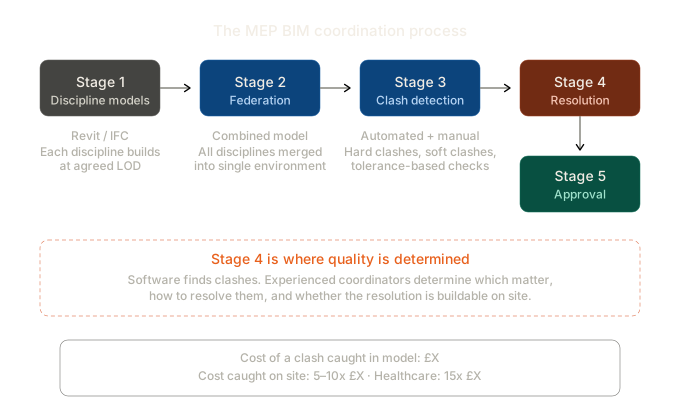
The process typically follows five stages. First, each discipline builds their systems in Revit at the agreed Level of Development, as defined in the project's BIM Execution Plan per ISO 19650. Second, these individual models are federated into a combined model. Third, clash detection identifies spatial conflicts. Fourth — and this is where quality is determined — an experienced coordinator reviews each clash, classifies it by severity, and proposes routing solutions. Fifth, the revised models go through approval with each discipline lead.
What separates good coordination from bad is stage four. Automated reports can generate thousands of clash points. Without someone who understands how these systems are actually installed on site — the bend radius of a duct, the clearance needed above a cable tray, the access requirements for valve maintenance — the clash report is just noise.
"An invaluable asset to any project team demanding expertise, precision, and successful delivery."
— Tony Joyce, Director of Engineering, Jones Engineering Group
The Cost of Getting It Wrong
Poor coordination shows up in predictable ways. Site teams discover that a duct run conflicts with a structural beam and need to reroute on the fly. Electrical contractors find their cable tray routes blocked by mechanical services that were installed first. Fire protection sprinkler heads end up too close to HVAC diffusers, compromising the spray pattern.
Each of these scenarios triggers a chain reaction: redesign, resubmission, approval delays, and physical rework. On complex projects, a single uncoordinated zone can cascade into weeks of programme delay. The cost of resolving a clash on site is typically 5–10x the cost of resolving it in the model — and on healthcare or data centre projects, that multiplier can reach 15x or more. (See our article on healthcare MEP coordination costs for the full breakdown.)
What to Look for in a Coordination Partner
Not all BIM coordination is equal. When evaluating a coordination partner, there are several factors that matter more than the software they use.
Site experience is the most overlooked factor. A coordinator who has spent years on construction sites understands installation sequences, access requirements, and the practical constraints that never show up in a model. They know that a pipe route might be geometrically clear but physically impossible to install because there's no scaffold access. (We've written about why site experience matters in detail.)
Delivery model matters too. Hourly-rate coordination creates a perverse incentive: the more clashes found, the more hours billed. A fixed-price model aligns the coordinator's interests with the project's interests — get it right, get it done, move on.
Communication quality separates professional coordination from amateur. Clear clash reports with proposed solutions — not just flagged problems — make the difference between a smooth project and a frustrating one.
When to Start MEP Coordination
The most common mistake is starting too late. By the time detailed design is complete and procurement has begun, the cost of changes increases dramatically. Early-stage coordination — even at a lower Level of Development — catches the major routing conflicts when they're still cheap to fix.
Ideally, coordination starts when discipline models reach LOD 300 and continues through to construction-ready LOD 350–500 deliverables (see our LOD 500 delivery guide for what each level means). Waiting until every model is "finished" before checking for clashes is like proofreading a book after it's been printed.
If your project is past RIBA Stage 4 without MEP coordination in progress, you're already behind the point where the biggest savings are available.
The Bottom Line
MEP BIM coordination is not a luxury or an optional add-on. For any project with meaningful MEP complexity — data centres, hospitals, pharmaceutical facilities, mixed-use developments — it's the process that prevents the most expensive category of construction errors. The question isn't whether you need it. It's whether you're doing it early enough and with people who understand what they're looking at.
Send us your BIM Execution Plan and discipline model list. We'll return a fixed-price proposal within 48 hours — no obligation, and you keep the scope assessment regardless.
Frequently Asked Questions
What is MEP BIM coordination?
MEP BIM coordination is the process of using 3D Building Information Models to detect and resolve conflicts between mechanical, electrical, and plumbing systems before construction. It involves federating discipline models, running clash detection, and producing coordinated construction drawings.
When should MEP coordination start on a project?
Coordination should start when discipline models reach LOD 300, typically during RIBA Stage 4 (Technical Design). Starting earlier catches major routing conflicts when they're cheapest to fix. Starting after procurement begins significantly limits resolution options.
How much does MEP BIM coordination cost?
Proper MEP coordination typically costs 1–3% of the total MEP package value. The cost of poor or absent coordination — in rework, programme delays, and site-based fixes — routinely runs to 5–15% of the MEP package, making coordination one of the highest-ROI investments on a construction project.
What is the difference between clash detection and MEP coordination?
Clash detection is one step within MEP coordination. It identifies geometric conflicts between building systems. Full MEP coordination includes clash detection, resolution proposals, installation feasibility review, maintenance access verification, and production of construction-ready drawings.
What software is used for MEP BIM coordination?
Most MEP coordination uses Autodesk Revit for modelling and Navisworks Manage for federated clash detection. The choice between them depends on project scale — see our Revit vs Navisworks comparison.