Managing Change Orders in BIM Coordination: The Cost of Getting It Wrong
A change order is a formal modification to a construction contract — a written acknowledgement that something needs to change after the design was supposed to be finalised. In MEP-intensive projects, change orders are among the most expensive disruptions a contractor faces, and the majority of them are preventable through early-stage BIM coordination.
A change order is a formal modification to a construction contract — a written acknowledgement that something needs to change after the design was supposed to be finalised. In MEP-intensive projects, change orders are among the most expensive disruptions a contractor faces, and the majority of them are preventable through early-stage BIM coordination.
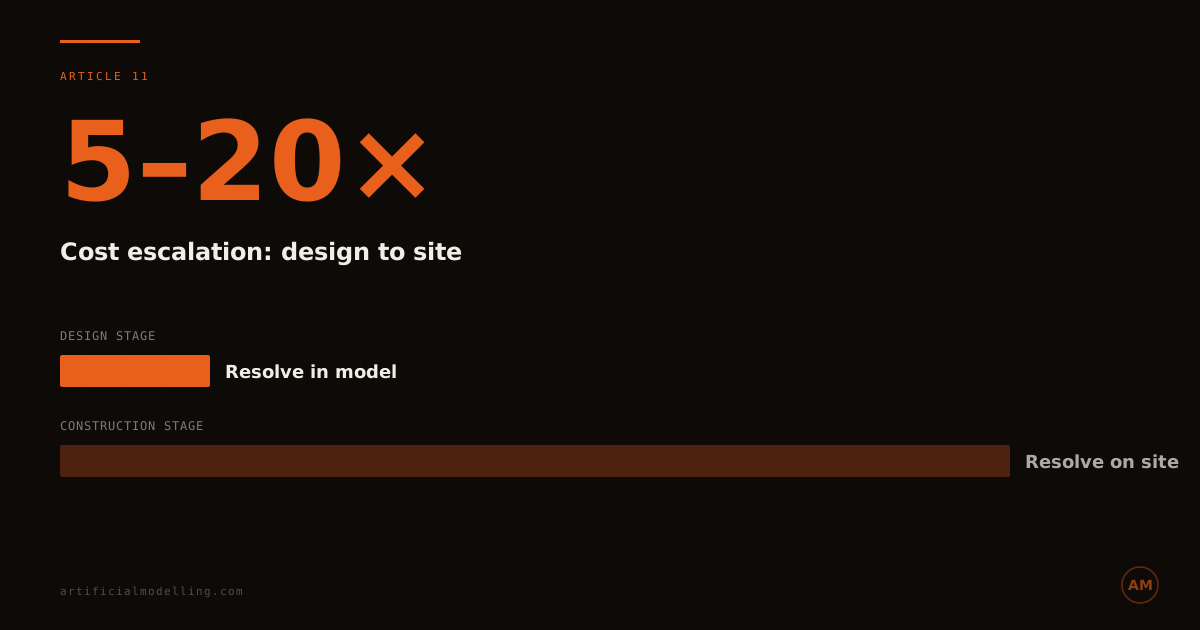
The construction industry operates on a well-documented cost escalation curve. Resolving a design conflict at concept stage costs approximately 1× the base effort. At detailed design stage, that same conflict costs roughly 5× to resolve. At construction stage — when steel is erected, services are partially installed, and trades are sequenced — the cost escalates to 10–20× the original resolution effort. This is the construction industry's widely-cited cost escalation principle — sometimes called the 1-5-20 rule. While exact ratios vary between studies, the directional principle is well-established and consistently observed in practice. It is the single strongest financial argument for investing in coordination before construction begins.
What Drives Change Orders on MEP Projects
The root causes of MEP-related change orders fall into three categories: spatial conflicts between building services, design information gaps between disciplines, and late-stage design revisions that cascade through coordinated systems.
Spatial conflicts are the most common. A mechanical duct routed through the same ceiling void as an electrical cable tray, with neither designer aware of the other's routing, will eventually produce a clash. If that clash is discovered on site — when the duct is partially installed and the cable tray brackets are already fixed to the soffit — the resolution requires demolition, redesign, re-fabrication, and reinstallation. A single spatial conflict of this nature on a commercial project can generate a change order valued between €15,000 and €50,000, depending on the systems involved and the programme impact.
Design information gaps are subtler. One discipline issues construction drawings based on an earlier revision of another discipline's model. The plumbing riser positions shift by 200mm between design stages, but the electrical distribution board layout doesn't update accordingly. The result is a site clash that nobody anticipated because the source data was never synchronised. These information-gap change orders are particularly frustrating for project teams because both designs were technically correct — they were just never checked against each other at the same point in time.
Late-stage design revisions are the most expensive trigger. When an architect modifies the ceiling height on three floors after MEP coordination is complete, every duct, pipe, and cable tray in those zones needs rechecking. If the revision happens after procurement, the fabricated components may no longer fit. The change order covers not just the coordination rework but the material waste and re-fabrication cost.
The Cost of Change Orders: Industry Data
Industry research consistently quantifies the financial impact of change orders on construction projects. Rework — the physical consequence of unresolved coordination issues — accounts for 5–12% of total construction costs on average, with the Construction Industry Institute (CII) reporting an average of 12% across its project database. On MEP-intensive projects without effective coordination, the figure sits at the higher end of this range. Research by Professor Peter Love (Construction Management and Economics) found that rework was responsible for 52% of total cost growth on the projects studied — meaning more than half of all budget overruns were attributable to work that had to be done twice.
On a €30 million commercial project, 10% rework represents €3 million in avoidable cost. Even at the lower bound of 5%, that is €1.5 million — a figure that dwarfs the cost of any coordination service.
The management overhead compounds the direct cost. Each change order triggers a sequence of administrative actions: the contractor issues a notice, the engineer reviews, the client responds, the subcontractor re-prices, and the programme is reassessed. Construction management overhead during active projects runs 8–12% of billing (CFMA industry benchmarks; Contractor Foreman). A single unresolved coordination issue requiring multiple meetings, RFIs, and revised shop drawings can consume over 40 hours of project management time — more than €3,000 in overhead before any physical rework begins.
How BIM Coordination Prevents Change Orders
BIM coordination intercepts the three root causes of change orders at the point where they are cheapest to resolve.
For spatial conflicts, the coordination process federates all discipline models into a single environment and runs automated clash detection. A clash between a DN600 supply duct and a 150mm cable tray is identified in the model, flagged with its exact location, and assigned to the responsible designer for resolution. The fix takes minutes in the model. On site, it would take days and cost thousands.
For information gaps, the coordination process enforces model currency. Every discipline submits their model at an agreed revision, and the coordination team verifies that all models are synchronised before running detection. This eliminates the class of change orders caused by stale data.
For late-stage revisions, the coordination process provides rapid impact assessment. When the architect changes the ceiling height, the coordinator can re-run detection within hours and produce a clash report showing exactly which services are affected. The design team can respond with targeted adjustments rather than a full re-coordination.
The Financial Case: Coordination Cost vs Change Order Cost
The cost of MEP BIM coordination on a commercial project typically ranges from €20 to €65 per square metre for standard complexity, and from 1% to 8% of construction value for consultancy-level engagement (PowerKH, 2025 — US market data; European rates vary by country). On a 10,000 sqm commercial building valued at €30 million, coordination might cost €60,000–€180,000.
Compare that to the cost of even a small number of change orders. Five spatial conflicts resolved on site at €20,000 each total €100,000 in direct cost — before management overhead, programme delays, or contractor claims. One major rerouting exercise on a data centre can exceed €200,000.
The return on coordination investment is consistently positive, often by a factor of 5–10× the coordination fee. BIM clash detection reduces design errors by over 70%, as confirmed by multiple academic case studies comparing 2D and 3D coordination outcomes (IJCRT 2025; ResearchGate case studies). On a documented case study — Haskell's €210 million design-build project — a €185,000 BIM coordination investment generated €2.4 million in avoided rework, a 10× return (cited by Revizto, Matterport, Construction Management and Economics).
What Good Change Order Prevention Looks Like
Effective change order prevention through BIM coordination is not just about running clash detection software. It requires understanding which clashes matter, which can be resolved through minor adjustments, and which represent fundamental design conflicts that need escalation.
A competent coordination team classifies clashes by severity: critical clashes that will halt installation, significant clashes that will require rework, and minor clashes that can be resolved during construction without formal change orders. This classification prevents the coordination process from generating noise — hundreds of reported clashes that overwhelm the design team and dilute attention from the issues that actually drive change orders.
The coordination programme should be aligned to the procurement schedule. Services that are being fabricated first need to be coordinated first. A clash detected after the ductwork is fabricated is a change order. A clash detected before fabrication is a model revision.
FAQ
How much does a typical construction change order cost?
MEP-related change orders on commercial projects typically range from €15,000 to €50,000 per incident for spatial conflicts. Major rerouting exercises on complex facilities such as data centres can exceed €200,000. The total cost includes direct rework, management overhead, and programme impact.
What is the 1-5-20 rule in construction?
The 1-5-20 rule is the construction industry's widely-cited cost escalation principle. A conflict resolved at concept stage costs approximately 1× the base effort. At detailed design, roughly 5×. At construction stage, 10–20×. While exact ratios vary between studies, the directional principle is well-established and consistently observed across project types.
Can BIM coordination eliminate all change orders?
No. BIM coordination eliminates change orders caused by spatial conflicts, information gaps, and uncoordinated design revisions. It does not prevent change orders caused by client-driven scope changes, unforeseen site conditions, or regulatory changes. However, coordination-related change orders typically represent the largest category on MEP-intensive projects.
What percentage of construction rework is caused by poor coordination?
Industry data places rework at 5–12% of total construction costs on average (CII, PlanRadar 2025 meta-analysis), with MEP-intensive projects at the higher end. A substantial proportion is attributable to coordination failures between disciplines. BIM clash detection reduces design errors by over 70%.
Artificial Modelling delivers fixed-price MEP BIM coordination that catches conflicts before they become change orders. Want to know what coordination costs on your project? Request a fixed-price proposal within 48 hours →