Fixed-Price vs Time & Materials: Which Costs Less Over 12 Months?
The choice between fixed-price and time & materials (T&M) BIM coordination is not just a procurement preference. It is a financial decision that compounds across every project. Over a 12-month period with multiple projects, the total cost difference between the two models becomes substantial — consistently favouring fixed-price.
The choice between fixed-price and time & materials (T&M) BIM coordination is not just a procurement preference. It is a financial decision that compounds across every project. Over a 12-month period with multiple projects, the total cost difference between the two models becomes substantial — consistently favouring fixed-price.
The reason is structural: T&M incentivises the coordinator to log hours, while fixed-price incentivises the coordinator to deliver efficiently. This incentive misalignment costs real money on every project.
The 12-Month Comparison
Consider a mid-sized contractor running 4 coordination projects in a 12-month period, each with an initial coordination scope estimated at €30,000.
T&M Model (Hourly Rate)
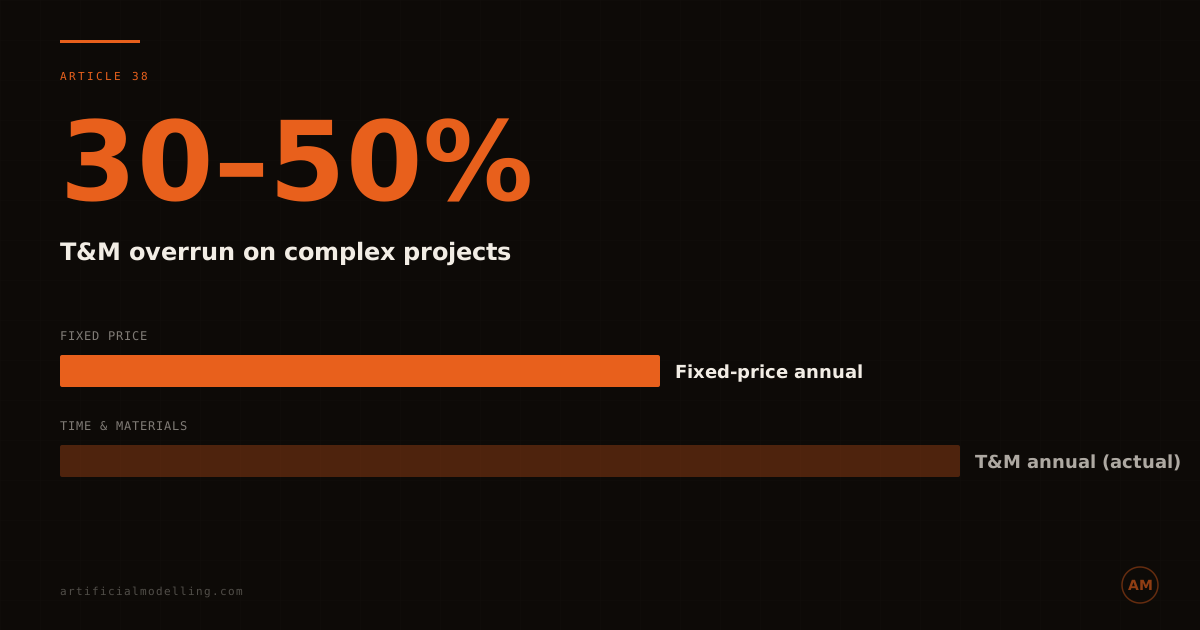
On an hourly-rate engagement, the initial estimate of €30,000 (375 hours at €80/hr) is exactly that — an estimate. Design revisions, additional coordination cycles, and scope evolution extend the programme beyond initial assumptions. Industry experience shows T&M coordination overruns by 30–50% on complex projects.
| Project | Initial Estimate | Actual Cost (35% avg overrun) | Overrun |
|---|---|---|---|
| Project 1 | €30,000 | €40,500 | +€10,500 |
| Project 2 | €30,000 | €39,000 | +€9,000 |
| Project 3 | €30,000 | €42,000 | +€12,000 |
| Project 4 | €30,000 | €37,500 | +€7,500 |
| Total | €120,000 | €159,000 | +€39,000 |
Add management overhead (20% PM time at €80K salary, allocated across 4 projects):
| PM overhead per project | €4,000 |
| PM overhead total | €16,000 |
| Total cost (T&M + overhead) | €175,000 |
Fixed-Price Model
On a fixed-price engagement, the coordination cost is agreed before work begins and does not change. The coordinator absorbs the risk of additional cycles and design revisions within the fixed fee. The fee is typically 10–15% above the T&M estimate to account for risk transfer.
| Project | Fixed Fee (15% premium) | Actual Cost | Overrun |
|---|---|---|---|
| Project 1 | €34,500 | €34,500 | €0 |
| Project 2 | €34,500 | €34,500 | €0 |
| Project 3 | €34,500 | €34,500 | €0 |
| Project 4 | €34,500 | €34,500 | €0 |
| Total | €138,000 | €138,000 | €0 |
PM overhead (5% PM time, self-managing partner):
| PM overhead per project | €1,000 |
| PM overhead total | €4,000 |
| Total cost (fixed + overhead) | €142,000 |
The Bottom Line
| Model | Annual Coordination Cost | Annual PM Overhead | Annual Total |
|---|---|---|---|
| T&M (hourly) | €159,000 | €16,000 | €175,000 |
| Fixed-price | €138,000 | €4,000 | €142,000 |
| Saving (fixed-price) | €33,000 (19%) |
The fixed-price model saves €33,000 per year — 19% of the T&M total — while providing complete budget certainty on every project.
FAQ
Don't fixed-price providers just inflate their fees to cover the risk?
Yes, and it is still cheaper. The 10–15% risk premium on a fixed-price fee is less than the 30–50% overrun that T&M engagements actually experience. The premium buys certainty, which is more valuable than an optimistic estimate that consistently misses.
What happens if the scope changes on a fixed-price project?
Scope changes are handled through a variation mechanism. If the client adds floors, changes the building design, or introduces new disciplines, the fixed-price is adjusted through a formal scope change — just as it would be on any construction contract.
Artificial Modelling uses fixed-price coordination exclusively. No hourly billing. No overruns. No surprises. Get your fixed-price quote →