Fixed-Price BIM Coordination — Why It Changes Everything for Contractors
Fixed-price BIM coordination eliminates cost uncertainty for the contractor and creates a direct incentive for the coordination team to work efficiently and get drawings approved on first submission.
Fixed-price BIM coordination is a delivery model where the entire MEP coordination scope — clash detection, resolution, drawing production, and revisions — is covered by a single agreed fee, rather than billed by the hour. It eliminates cost uncertainty for the contractor and creates a direct incentive for the coordination team to work efficiently and get drawings approved on first submission. For projects with a defined scope and clear deliverables, it consistently outperforms hourly-rate coordination on both cost and quality.
Here's why the industry default of hourly billing creates problems, and how fixed-price changes the equation.
The Problem with Hourly-Rate Coordination
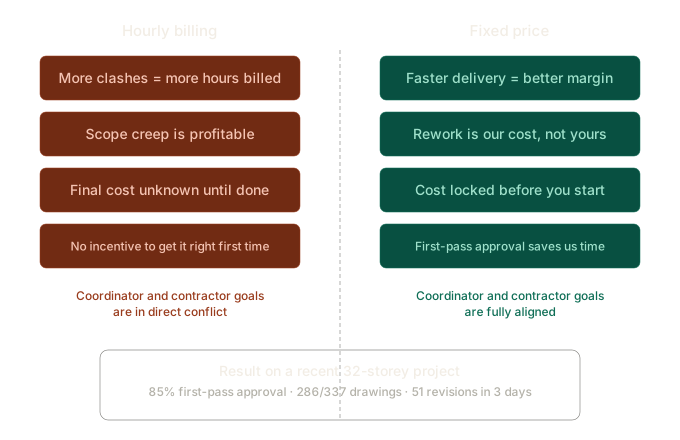
When coordination is billed by the hour, the service provider has no financial incentive to work efficiently. More clashes found means more resolution time billed. More review cycles means more hours logged. There's no natural endpoint, no budget ceiling, and no shared pressure to close issues quickly.
For the contractor, this creates budget uncertainty at exactly the wrong time — during the phase when they're trying to lock down costs for construction. The NBS National BIM Report consistently shows that "cost" and "lack of understanding of the benefits" are the top barriers to BIM adoption. Hourly billing makes both worse.
The hourly model also creates a reluctance to coordinate thoroughly. When every additional check costs money, project managers start making trade-offs: "Can we skip the coordination on floors 8 through 12? They're basically the same as floor 7." Those skipped floors always come back as site problems later. Every shortcut taken during coordination creates a multiplied cost during construction.
How Fixed-Price Coordination Works
A fixed-price model starts with a clear scope definition. The coordination partner reviews the project information — discipline models, BIM Execution Plan, programme milestones, deliverable requirements — and produces a fixed fee for the complete coordination scope.
That fee covers clash detection, resolution proposals, coordination meetings, drawing production, and a defined number of revision cycles. The scope is documented. The deliverables are specified. The price doesn't change unless the scope does.
This creates alignment. The coordination team is incentivised to work efficiently because any waste comes out of their margin, not your budget. They're incentivised to get drawings approved on first submission because every rejected submission costs them time, not you money.
On a recent 32-storey project, this incentive structure contributed directly to an 85% first-pass drawing approval rate — 286 out of 337 drawings approved with zero revisions on first submission.
"286 out of 337 drawings approved first submission — zero revisions. Remaining 51 resolved in 3 days. Exceptional."
— Jacek Myga, Tier 1 Subcontractor, 32-Storey UK Project
What the Contractor Gets
Budget certainty is the obvious benefit, but it's not the only one. Fixed-price coordination also shifts the relationship dynamic.
When a contractor is paying hourly, there's always a background tension: is this taking longer than it should? Are they padding hours? These questions are corrosive to a working relationship, even when the answers are benign. With fixed-price, those questions disappear. The coordination team has a clear incentive to deliver quality work efficiently, and the contractor can evaluate performance on output quality rather than input hours.
According to RICS construction cost guidance, coordination and design management costs on complex MEP projects typically represent 1–3% of the total services package value when properly scoped. The cost of coordination failures — rework, programme delays, redesign fees — routinely runs to 5–15%. Fixed-price makes that 1–3% predictable and removes the risk of the coordination process itself becoming a cost overrun.
When Fixed-Price Works Best
Fixed-price coordination is most effective when the scope is clearly defined. Projects with a finalised design scope, an agreed BIM Execution Plan per ISO 19650, and clear deliverable milestones are ideal candidates. The model works especially well for complex, high-MEP-density projects — data centres, hospitals, pharmaceutical facilities — where the coordination effort is substantial and predictable.
It's less suitable for projects in very early design stages where the scope is still shifting significantly. In those cases, a phased approach works better: a fixed fee for early-stage coordination through to a defined milestone, with a separate fixed fee for detailed coordination once the design stabilises.
The Competitive Advantage
Contractors who switch to fixed-price coordination typically find two things. First, their overall coordination costs decrease because the provider is working efficiently rather than billing for every iteration. Second, the quality of deliverables improves because the coordination team is focused on getting to approved status as quickly and cleanly as possible.
In an industry where margins are tight and programme delays are expensive, predictable costs and aligned incentives are not minor advantages. They change how coordination gets done.
Send us your BIM Execution Plan and model list. We'll return a detailed, no-obligation proposal within 48 hours — including scope, deliverables, timeline, and a single fixed fee. You keep the scope assessment regardless.
Frequently Asked Questions
How does fixed-price BIM coordination work?
The coordination partner reviews your project scope — discipline models, BIM Execution Plan, deliverable requirements — and provides a single fixed fee covering clash detection, resolution, drawing production, and agreed revision cycles. The price is locked unless the project scope changes.
Is fixed-price BIM coordination cheaper than hourly?
Typically yes, because the coordination team is incentivised to work efficiently. On hourly billing, inefficiency is billable. On fixed-price, it's a cost to the provider. Most contractors see lower total coordination costs and higher quality deliverables.
What if the project scope changes after the fixed price is agreed?
Scope changes are handled through a documented variation process — same as any construction contract. The original scope is clearly defined, and any additions are priced as discrete variations with your approval before proceeding.
What's included in a fixed-price BIM coordination fee?
A typical scope includes: model federation, clash detection and classification, resolution proposals, coordination meetings, construction drawing production, and an agreed number of revision cycles. Specific inclusions are documented in the scope agreement before work begins.