Fire Protection Design: EN 12845 vs NFPA 13 — The Cost Difference on the Same Building
Fire protection design for a single building can be executed to different standards depending on jurisdiction, client preference, and insurer requirements. The two dominant standards in Europe are EN 12845 (the European standard, widely adopted in the UK, Ireland, and continental Europe) and NFPA 13 (the American standard, commonly specified on projects with US-based clients, international insurers, or multinational occupiers).
Fire protection design for a single building can be executed to different standards depending on jurisdiction, client preference, and insurer requirements. The two dominant standards in Europe are EN 12845 (the European standard, widely adopted in the UK, Ireland, and continental Europe) and NFPA 13 (the American standard, commonly specified on projects with US-based clients, international insurers, or multinational occupiers).
The standards produce different designs for the same building. EN 12845 and NFPA 13 differ in hazard classification methodology, water density requirements, area of operation calculations, and pipe sizing rules. These differences are not academic — they translate directly into different pipe sizes, different pump capacities, different tank volumes, and different spatial requirements in the ceiling void and riser shafts.
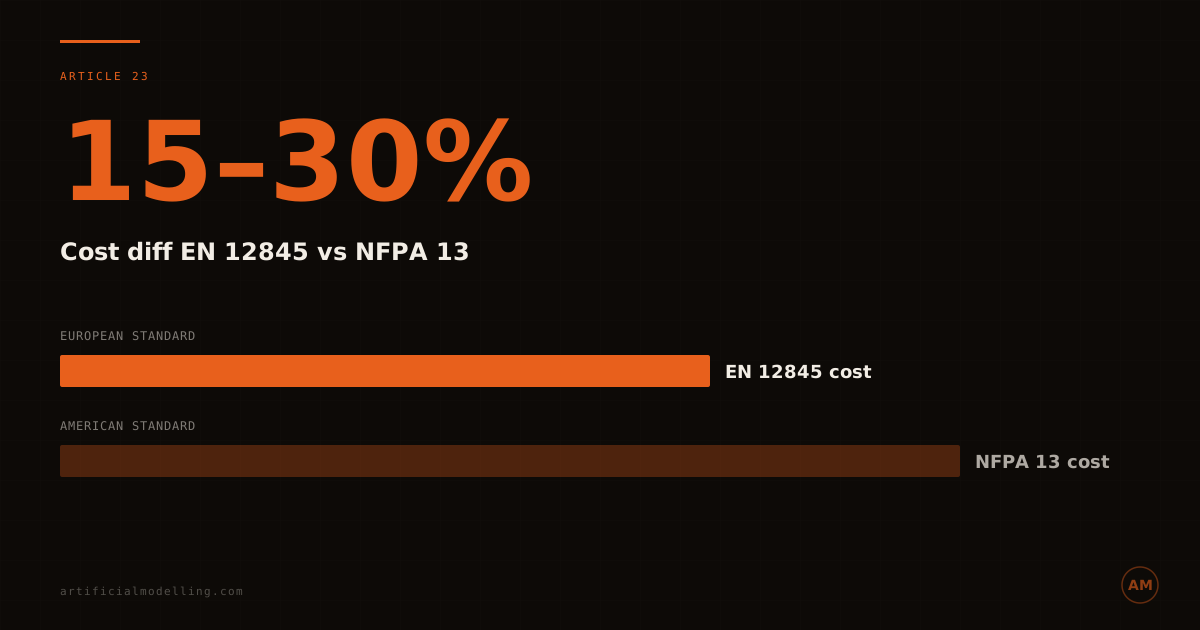
The cost difference between EN 12845 and NFPA 13 compliance on the same building typically ranges from 15–30% of the fire protection installation cost. On a €500,000 fire protection package, that is €75,000–€150,000. The choice of standard also affects MEP coordination, because larger pipe sizes require more ceiling void space and larger riser shafts.
Where the Standards Diverge
Hazard classification is the fundamental difference. EN 12845 classifies occupancies into Light Hazard (LH), Ordinary Hazard Groups 1–4 (OH1–OH4), and High Hazard categories. NFPA 13 uses Light Hazard, Ordinary Hazard Groups 1 and 2, and Extra Hazard Groups 1 and 2. The same building occupancy may fall into different hazard categories under each standard, resulting in different design densities.
Water density and area of operation determine the total water demand. NFPA 13 typically requires higher water densities over larger areas of operation than EN 12845 for equivalent occupancy types. This means larger pipe sizes, higher flow rates, and bigger pumps under NFPA 13 — all of which increase both cost and spatial demand.
Pipe sizing rules differ in their approach to hydraulic calculation and allowable friction loss. EN 12845 permits slightly higher velocities in pipework, which can result in smaller pipe diameters for the same flow rate. NFPA 13 is more conservative, often requiring one size larger for equivalent flows.
The MEP Coordination Impact
The choice of standard directly affects MEP coordination in three ways.
Ceiling void demand: NFPA 13 designs typically require 10–20% more ceiling void space for sprinkler mains and branch lines than EN 12845 designs for the same building. On a project where the ceiling void is already tight — as it is on most MEP-dense buildings — this additional demand creates more clashes with mechanical and electrical services.
Riser shaft sizing: Larger pipe diameters under NFPA 13 require larger riser shaft openings. If the structural design was based on EN 12845 pipe sizes and the project subsequently switches to NFPA 13, the riser penetrations may be undersized — requiring structural modifications or additional penetrations.
Pump room footprint: Higher flow rates under NFPA 13 require larger pumps and larger storage tanks. The pump room footprint may increase by 15–25%, affecting the plantroom layout and the routing of all services connecting to the plantroom.
The Cost Comparison
| Component | EN 12845 (Typical) | NFPA 13 (Typical) | Difference |
|---|---|---|---|
| Sprinkler pipework (materials + labour) | €300,000 | €360,000–€390,000 | +20–30% |
| Pump set | €40,000 | €50,000–€60,000 | +25–50% |
| Water storage tank | €25,000 | €30,000–€40,000 | +20–60% |
| Total fire protection | €365,000 | €440,000–€490,000 | +20–34% |
| Additional MEP coordination effort | Baseline | +€8,000–€15,000 | — |
These figures are indicative for a 10,000 sqm commercial building. Actual costs vary by project specifics, but the directional difference between standards is consistent.
What This Means for Clients
The choice between EN 12845 and NFPA 13 should be made before MEP coordination begins — not during it. Switching standards mid-coordination requires re-design of the fire protection system, re-coordination of every zone affected by changed pipe sizes, and potentially structural modifications for enlarged penetrations.
A mid-project standard switch on a €30 million building can cost €100,000–€250,000 in redesign, re-coordination, and construction delay. Making the decision before coordination starts costs nothing.
FAQ
Is EN 12845 or NFPA 13 cheaper?
EN 12845 typically produces a 15–30% lower installation cost than NFPA 13 for the same building, due to different hazard classification, water density requirements, and pipe sizing rules.
Can a building comply with both standards?
Technically yes, by designing to the more onerous requirement at every point. In practice, this produces a conservative and expensive design. Most projects choose one standard and design to it consistently.
Which standard should I specify?
EN 12845 is the default for most UK, Irish, and European projects. NFPA 13 is typically required when specified by the client, the insurer, or the authority having jurisdiction (AHJ). If in doubt, confirm with the project insurer before coordination begins.
Artificial Modelling coordinates fire protection systems to both EN 12845 and NFPA 13. Fixed-price. Standard-aware. Get a quote →