How to Evaluate a BIM Coordination Partner: Hidden Costs of Choosing Wrong
Selecting a BIM coordination partner is a procurement decision with disproportionate financial consequences. The coordination fee itself is typically 1–8% of MEP construction value (PowerKH, 2025 — US market data) — a modest line item on any project budget. But the cost of choosing the wrong partner manifests in rework, programme delays, management overhead, and subcontractor claims that can exceed the coordination fee by a factor of 10–20.
Selecting a BIM coordination partner is a procurement decision with disproportionate financial consequences. The coordination fee itself is typically 1–8% of MEP construction value (PowerKH, 2025 — US market data) — a modest line item on any project budget. But the cost of choosing the wrong partner manifests in rework, programme delays, management overhead, and subcontractor claims that can exceed the coordination fee by a factor of 10–20.
The hidden cost of poor coordination is not the coordinator's fee. It is the cost imposed on every other party when coordination fails: the mechanical contractor who fabricates ductwork that does not fit, the electrical contractor whose cable tray clashes with the plumbing riser, and the project manager who spends weeks managing the fallout instead of managing the project.
The 7 Evaluation Criteria
1. Sector-Specific Experience
A coordinator who excels at commercial office buildings may struggle with data centre density or hospital compliance requirements. Ask for project references in your sector specifically. Data centres, healthcare, pharmaceutical, and education buildings each have coordination requirements that general BIM experience does not cover.
Hidden cost of ignoring this: Sector-naive coordination misses discipline-specific requirements. A coordinator unfamiliar with clean room pressure cascade requirements on a pharmaceutical project will produce a coordinated model that fails compliance review — triggering a full re-coordination at the client's expense.
2. Pricing Model Transparency
Understand exactly what is included in the fee. Hourly-rate models create open-ended financial risk. Fixed-price models transfer the risk to the coordinator — but only if the scope is clearly defined. Ask what happens when the scope changes mid-project.
Hidden cost of ignoring this: An hourly-rate coordinator on a complex project with multiple design revisions can bill 40–60% more than the original estimate. On a €100,000 coordination scope, this means €40,000–€60,000 in unbudgeted cost.
3. Site Experience
Coordination conducted exclusively from an office produces models that look correct on screen but fail on site. Ask whether the coordination team has construction site experience — not just BIM software experience. A coordinator who has walked a site understands installation clearances, access requirements, and the physical reality of building services in a way that a screen-only coordinator cannot.
Hidden cost of ignoring this: Coordination without site knowledge generates solutions that are geometrically correct but practically unbuildable. A duct offset that fits in the model but requires a crane lift through an inaccessible zone is not a solution — it is a change order waiting to happen.
4. First-Pass Approval Rate
Ask for documented first-pass approval rates on previous projects. The industry average for construction drawing submissions is approximately 60–65%. A coordination partner consistently achieving 80–85% is delivering measurably fewer review cycles, fewer RFIs, and less PM time spent managing submissions.
Hidden cost of ignoring this: Each rejected drawing submission triggers a revision cycle: the coordinator revises, the designer reviews, the contractor re-issues. At 2–4 hours per revision cycle and €80–€100/hr for coordinator time, 50 rejected submissions cost €8,000–€20,000 in revision effort alone — before counting the PM time to manage the process.
5. Team Stability and Capacity
Ask who will actually do the work. A firm that wins the bid with their senior team but delivers with junior staff is a common pattern. Understand the team structure, the experience level of the lead coordinator, and what happens if the project scales beyond the initial scope.
Hidden cost of ignoring this: A junior coordinator working at 60% of senior coordinator productivity extends the coordination programme by 40%. On a 6-month programme, that is 2.4 additional months of coordination — potentially €30,000–€60,000 in extended fees.
6. Management Overhead They Create
This is the criterion most clients skip. When a contractor engages a BIM coordinator, someone in the contractor's organisation has to manage that relationship — reviewing outputs, attending coordination meetings, handling RFIs, quality-checking clash reports. If a manager earning €80,000/year spends 20% of their time managing one coordinator, that is €16,000/year in invisible overhead.
A self-managing coordination partner reduces this overhead to 2–5%. Ask how they structure their delivery to minimise the client's management burden.
Hidden cost of ignoring this: €16,000/year in management time that never appears on the coordination budget line. Over a 12-month project, this is equivalent to adding 20% to the coordination fee.
7. Quality Assurance Process
Ask what QA/QC process the coordinator applies before issuing deliverables. A coordinator who issues clash reports without reviewing them for duplicates, false positives, and priority classification creates work for the design team instead of reducing it. Ask to see a sample deliverable — a coordination report or clash summary — from a previous project.
Hidden cost of ignoring this: An unfiltered clash report with 2,000 items when 400 are genuine requires the design team to spend 40+ hours sorting signal from noise — over €3,000 in wasted effort per coordination cycle.
The Decision Framework
The total cost of a coordination partner is not the fee they charge. It is the fee plus the management overhead they create, plus the rework they fail to prevent, plus the programme delay from coordination that takes longer than it should.
A partner charging €80,000 who prevents €200,000 in rework, creates minimal management overhead, and delivers within programme is cheaper than a partner charging €50,000 who fails to catch critical clashes, requires intensive management, and extends the coordination timeline by 8 weeks.
FAQ
What does poor BIM coordination cost?
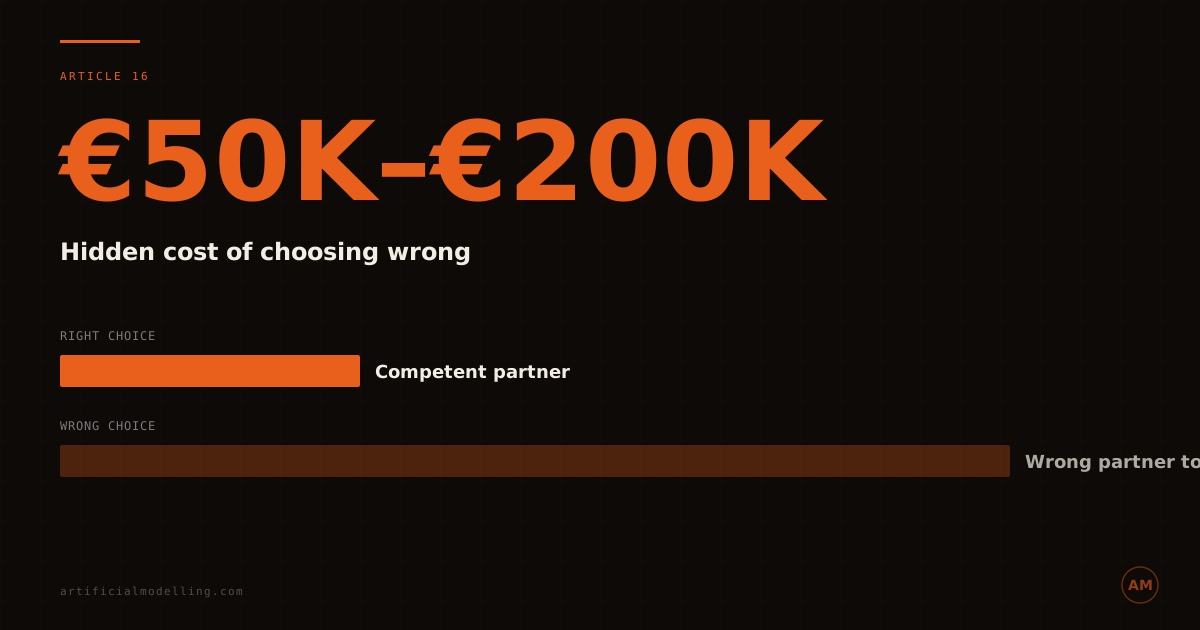
The total cost of choosing the wrong coordination partner ranges from €50,000 to €200,000+ on a typical commercial project. This includes direct rework from missed clashes, management overhead from intensive supervision requirements, and programme impact from extended coordination timelines.
Should I choose the cheapest BIM coordination bid?
No. Coordination is a risk management function, not a commodity service. The cheapest bid often correlates with the lowest capability. Evaluate on the 7 criteria above and calculate total cost of engagement — including the hidden costs — not just the coordination fee.
Artificial Modelling delivers fixed-price, self-managing MEP BIM coordination. Minimal overhead. Maximum prevention. Request a proposal →