Data Centre MEP: The Cost of Poorly Coordinated High-Density Power Distribution
High-density power distribution is the defining MEP challenge in data centre construction.
High-density power distribution is the defining MEP challenge in data centre construction. A single data hall in a hyperscale facility may require 5–10MW of electrical capacity delivered through a network of transformers, switchgear, UPS systems, power distribution units (PDUs), busbar trunking, and cable containment that must be coordinated with millimetre precision against cooling infrastructure, fire suppression systems, and the structural frame.
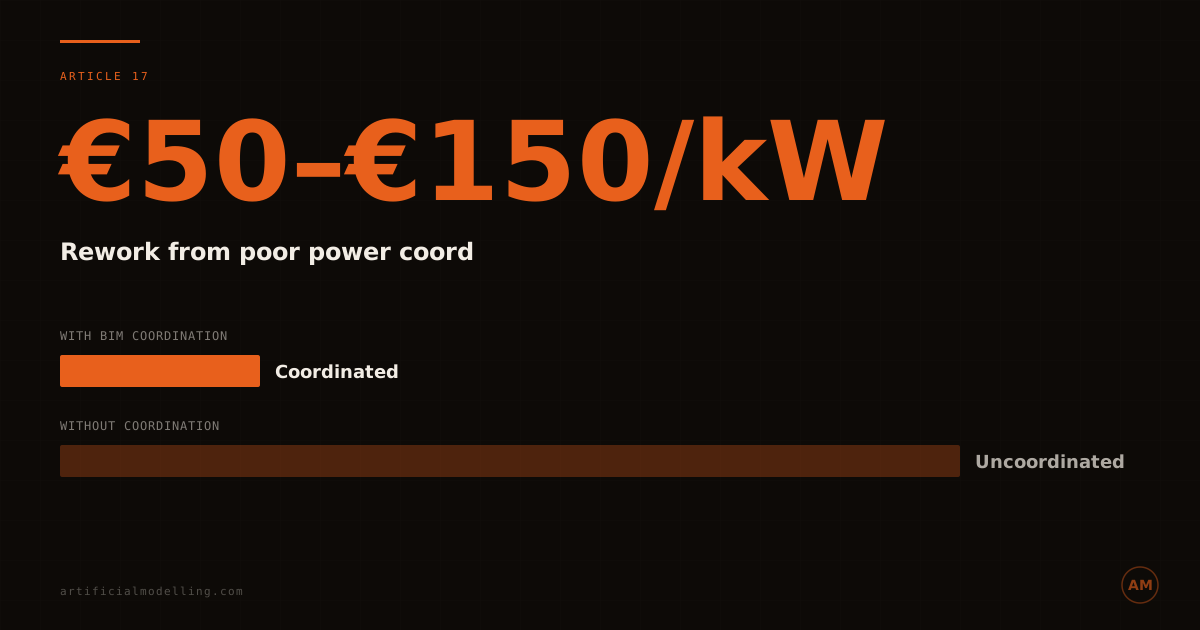
The cost of poorly coordinated power distribution is measured per kilowatt. Industry experience indicates that rework attributable to electrical coordination failures on data centre projects costs €50–€150 per kW of installed capacity. On a 10MW data hall, this represents €500,000–€1.5 million in avoidable rework — a figure that far exceeds the cost of thorough BIM coordination.
Why Data Centre Power Coordination Is Different
Standard commercial electrical distribution involves relatively low power densities — typically 50–100W per square metre. Data centres operate at 1,000–3,000W per square metre, with some high-performance computing facilities exceeding 5,000W/sqm. This density creates three coordination challenges that do not exist in commercial construction.
First, the physical size of electrical infrastructure is substantially larger. A 2MW transformer occupies a room-sized footprint with specific clearance requirements for ventilation, maintenance access, and cable entry. Busbar trunking serving a data hall is 400–800mm wide and requires continuous support from the structural frame. Cable containment for thousands of power and data cables creates dense layers in raised floor and overhead tray systems. All of these elements compete for space with mechanical cooling infrastructure that is equally large and equally inflexible in its routing.
Second, redundancy requirements create parallel systems that must be coordinated independently. A Tier III data centre requires concurrent maintainability — the ability to maintain any single component without interrupting IT operations. This means dual power paths (A+B feeds), dual cooling paths, and dual fire suppression systems, each requiring its own routing corridor through the building. Coordinating one power path is complex. Coordinating two parallel paths with independent maintenance access is an order of magnitude more demanding.
Third, the installation sequence is critical. Electrical infrastructure in data centres follows a strict commissioning sequence: transformers first, then main switchgear, then distribution boards, then busbar, then final circuits. If a coordination conflict is discovered during busbar installation that requires relocating a transformer, the programme impact cascades through every subsequent activity. A two-week delay in transformer commissioning on a facility with €200,000/week in programme costs means €400,000 in delay costs from a single coordination failure.
The Cost Breakdown
Rework on data centre electrical systems manifests in several forms:
Cable tray rerouting after installation conflicts with cooling pipework is the most common issue. Rerouting an installed cable tray run — removing it, modifying supports, cutting to new lengths, and reinstalling — costs €100–€300 per linear metre. A major reroute of 50 metres costs €5,000–€15,000 per instance.
Busbar realignment due to structural clashes or clearance violations is the most expensive single-item rework. Relocating an installed busbar section requires disconnection, removal, fabrication of new sections, reinstallation, and retesting. The cost per busbar modification ranges from €10,000 to €50,000 depending on the system rating and the extent of modification required.
Raised floor modifications to accommodate power distribution that was not coordinated with the underfloor plenum layout adds €200–€500 per floor tile. On a data hall with 200 affected tiles, this adds €40,000–€100,000.
Testing and commissioning delays caused by incomplete or reworked electrical installations carry indirect costs of €50,000–€200,000 per week of delay on a hyperscale facility, depending on the contractual structure and the client's revenue loss from delayed go-live.
The Coordination Approach
Effective power distribution coordination in data centres requires a multi-phase approach. Early-stage coordination establishes routing corridors for primary electrical infrastructure — transformer positions, main cable routes, busbar alignment — before any mechanical coordination begins. The electrical and mechanical teams then coordinate in parallel, with regular cross-discipline reviews to resolve priority conflicts.
The key principle is that electrical distribution follows fixed paths determined by switchgear locations and redundancy requirements. Cooling infrastructure has more routing flexibility. When conflicts arise, the default resolution is to adjust mechanical routing around fixed electrical paths — not the reverse. This priority hierarchy must be agreed before coordination begins and enforced throughout the process.
FAQ
How much does electrical coordination rework cost on a data centre?
Rework attributable to electrical coordination failures costs €50–€150 per kW of installed capacity. On a 10MW facility, this represents €500,000–€1.5 million in avoidable cost. The majority of this rework is preventable through early-stage BIM coordination.
Why is data centre electrical coordination more complex than commercial?
Data centres operate at 10–30× the power density of commercial buildings, require dual redundant power paths for concurrent maintainability, and follow strict commissioning sequences where delays cascade through the programme.
What is the typical coordination cost for a data centre electrical system?
MEP BIM coordination for data centres, including electrical systems, typically costs €55–€160 per square metre (PowerKH, 2025 — converted to EUR and metric) for complex facilities. This is 2–3× the cost of standard commercial coordination, reflecting the density and redundancy requirements.
Artificial Modelling coordinates high-density power distribution for data centres across Europe. Fixed-price. Redundancy-aware. Start a conversation →