Data Centre Cooling System Coordination: The Cost of Failure During Commissioning
Cooling system coordination in data centres is the highest-stakes MEP coordination activity in construction. A cooling failure during commissioning — where the installed system cannot achieve the design cooling capacity because of coordination-related installation defects — delays the entire facility go-live.
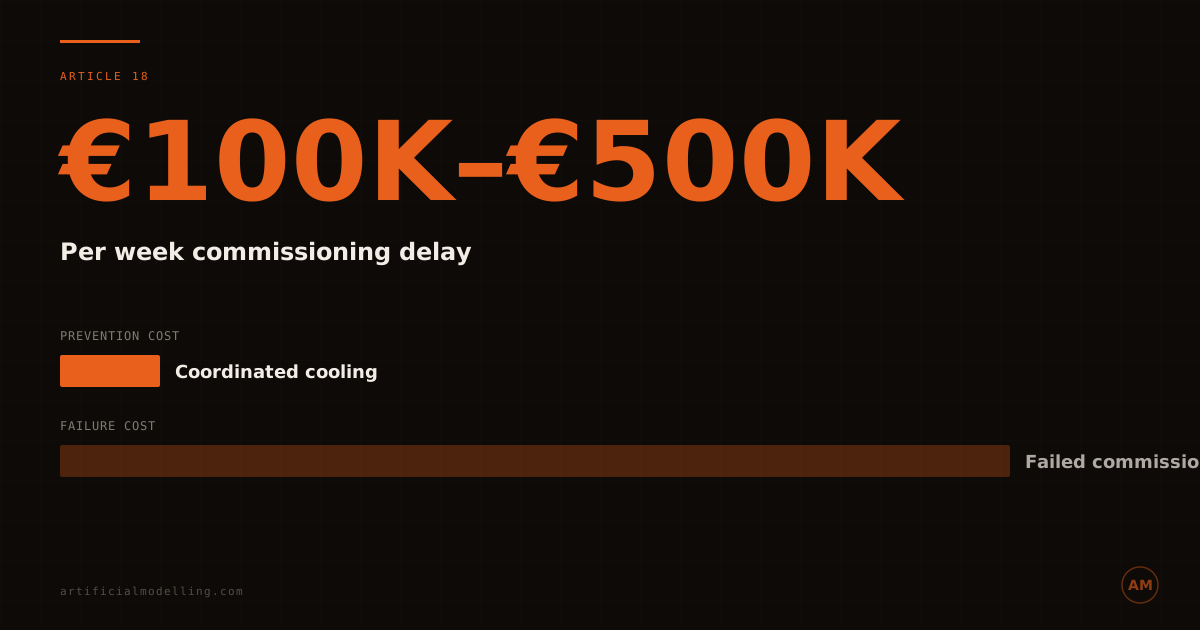
Cooling system coordination in data centres is the highest-stakes MEP coordination activity in construction. A cooling failure during commissioning — where the installed system cannot achieve the design cooling capacity because of coordination-related installation defects — delays the entire facility go-live. For a hyperscale data centre, the delay cost ranges from €100,000 to €500,000 per week in extended preliminaries, liquidated damages, and the client's lost revenue opportunity.
The cooling system in a modern data centre typically accounts for 30–40% of the total MEP installation cost. On a €50 million MEP package, cooling represents €15–€20 million. The coordination effort required to deliver this system clash-free is proportionally substantial — but it is a fraction of the cost of commissioning failure.
The Coordination Challenge
Data centre cooling systems are fundamentally different from commercial HVAC in three ways that affect coordination.
Scale: Chilled water pipework in a data centre operates at diameters — DN200 to DN500 for primary loops — that dwarf commercial systems. A DN400 chilled water pipe with insulation, hangers, and service clearance occupies a corridor 800mm wide through the building. Routing these pipes through a building that also contains matching-scale power distribution infrastructure is a spatial puzzle with very few degrees of freedom.
Precision: Hot aisle/cold aisle configurations require precise delivery of chilled air or water to specific locations. A computer room air handling unit (CRAH) serving a row of server cabinets needs its supply and return pipework to connect at exact locations. If the pipework is installed 500mm off position because of a coordination conflict with cable containment, the CRAH may not physically connect — requiring field modification that compromises system performance.
Redundancy: Like power distribution, cooling systems in Tier III and Tier IV data centres require concurrent maintainability. Dual cooling paths — typically A and B loops — must each be capable of carrying the full cooling load independently. Each loop requires independent routing, isolation valves, and maintenance access. Coordinating dual parallel paths through a building that already has dual parallel power paths leaves almost no unallocated space in the services zones.
What Cooling Coordination Failures Cost
Cooling coordination failures manifest during three project phases, with escalating cost at each phase.
During construction: Pipework installed in the wrong location requires cutting, removing, re-fabricating, and reinstalling. Chilled water pipework modifications at DN300+ involve welded connections, pressure testing, flushing, and insulation reinstatement. The cost per modification ranges from €5,000 to €30,000 depending on pipe size and accessibility. A facility with 10–20 significant cooling pipework clashes faces €50,000–€600,000 in direct rework cost.
During testing and commissioning: Cooling systems that have been reworked on site may not achieve design flow rates because of non-standard fittings, additional bends, or reduced cross-sections introduced during field modifications. Rebalancing a commissioning-failing cooling system can require 2–6 weeks of additional commissioning time. At €100,000–€500,000 per week in delay costs, the commissioning failure alone can exceed €1 million.
During operation: Cooling systems installed with coordination-related compromises operate at reduced efficiency. An additional 3–5 pressure-drop-inducing bends in a primary loop increases pumping energy by 5–10%. Over the 15–20 year operating life of a data centre, this energy cost penalty can exceed the construction cost of the pipework modification that caused it.
The Prevention Cost
The cost of comprehensive cooling system coordination within a full MEP BIM coordination service adds approximately 15–25% to the coordination effort compared to a project without cooling system complexity. On a €100,000 coordination fee, this represents €15,000–€25,000 of additional effort.
Compare this to the cost of a single significant cooling coordination failure — €30,000–€600,000 in direct rework, plus potential commissioning delay at €100,000–€500,000 per week. The coordination investment pays for itself with the prevention of a single major clash.
FAQ
How much does a cooling system failure cost during data centre commissioning?
Cooling system failures during commissioning typically cost €100,000–€500,000 per week in delay costs, including extended preliminaries, liquidated damages, and the client's lost revenue opportunity. Direct rework of cooling pipework adds €50,000–€600,000 depending on the number and severity of coordination failures.
What is the most common cooling coordination failure in data centres?
The most common failure is chilled water pipework conflicting with electrical cable containment in shared services corridors. Both systems require large routing corridors and neither can be easily rerouted once installed. Resolving this conflict requires early-stage priority agreement and parallel coordination of both systems.
How much does cooling coordination add to the BIM coordination fee?
Comprehensive cooling system coordination adds approximately 15–25% to the MEP BIM coordination fee. On a typical data centre project, this represents €15,000–€25,000 of additional coordination effort — a fraction of the cost of a single significant cooling coordination failure.
Artificial Modelling coordinates cooling systems for data centres across Ireland, the UK, and Europe. Fixed-price. Commissioning-focused. Talk to us →