The Business Case for Fixed-Price BIM Coordination: A Full ROI Framework
The return on investment for fixed-price BIM coordination is not a theoretical projection. It is a calculable comparison between three cost categories: the coordination fee, the rework it prevents, and the management overhead it eliminates. On every metric, the coordination investment returns a positive multiple of its cost.
The return on investment for fixed-price BIM coordination is not a theoretical projection. It is a calculable comparison between three cost categories: the coordination fee, the rework it prevents, and the management overhead it eliminates. On every metric, the coordination investment returns a positive multiple of its cost.
This article presents the full ROI framework using a worked example on a €30 million commercial project — a mid-range data centre, hospital wing, or large mixed-use development. The numbers are based on publicly available industry data and are structured so that any engineering director, commercial manager, or CFO can verify them independently.
The Worked Example: €30 Million Project
The Coordination Investment
MEP BIM coordination for a project of this size and complexity typically costs 1.5–3% of MEP value. With MEP representing 30% of construction cost (€9 million), the coordination fee ranges from €135,000 to €270,000. We use €200,000 as the baseline.
What the Investment Prevents
Rework prevention: Industry data places rework at 5–12% of total construction costs on average, with the Construction Industry Institute (CII) reporting an average of 12% across its project database. Using a mid-range estimate of 10% on a €30 million project, the rework exposure is €3 million. BIM clash detection reduces design errors by over 70% (multiple academic case studies; IJCRT 2025). A 70% reduction in coordination-related rework — conservatively estimated at 50% of all rework — prevents €1,050,000 in rework cost.
Programme protection: Research by Professor Peter Love (Construction Management and Economics) found that rework was responsible for 52% of total cost growth on the projects studied. A 4-week programme delay on a project with €150,000/month in general preliminaries costs €150,000 in extended overheads alone — before liquidated damages. Coordination that prevents the clashes causing the delay saves at minimum €150,000 in programme costs.
Management overhead elimination: When coordination is managed externally on a fixed-price basis, the client's PM reviews final deliverables — not intermediate work. Management time drops from 15–25% to 2–5%. For a PM earning €80,000/year, the saving is €8,000–€16,000 per year. Over a 2-year project, that is €16,000–€32,000.
The ROI Calculation
| Category | Without Coordination | With Fixed-Price Coordination | Saving |
|---|---|---|---|
| Rework cost (10% × 50% coordination-related × 70% prevention) | €1,500,000 | €450,000 | €1,050,000 |
| Programme delay (4 weeks avoided) | €150,000 | €0 | €150,000 |
| Management overhead (2 years) | €32,000 | €6,400 | €25,600 |
| Total saving | €1,225,600 | ||
| Coordination fee | €200,000 | ||
| Net saving | €1,025,600 | ||
| ROI | 6.1× |
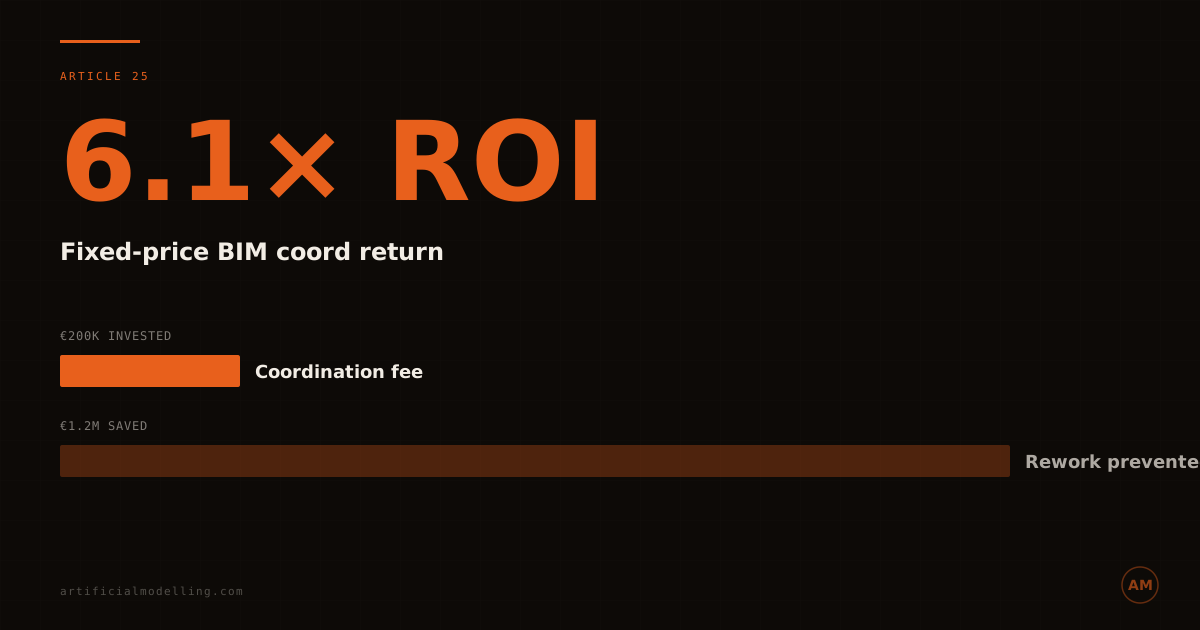
The €200,000 coordination investment returns €1,225,600 in avoided costs — a 6.1× return. Even with conservative assumptions (lower rework rates, shorter delays), the return remains 3–5×.
The Fixed-Price Premium
Fixed-price coordination offers an additional benefit over hourly-rate coordination: budget certainty. On a fixed-price engagement, the coordination cost is known before the project starts. On an hourly engagement, the final cost depends on the number of design revisions, the volume of clashes, and the duration of the coordination programme — all of which are unpredictable.
Industry data suggests that hourly-rate coordination bills 30–50% more than the original estimate on complex projects, because design revisions extend the coordination programme beyond initial assumptions. A coordination scope estimated at €150,000 on an hourly basis may reach €195,000–€225,000. The same scope on a fixed-price basis is €150,000 — guaranteed.
FAQ
What ROI does BIM coordination deliver?
Fixed-price BIM coordination typically delivers 5–10× return on investment through rework prevention, programme protection, and management overhead elimination. On a €30 million project with a €200,000 coordination fee, the demonstrated saving is €1.2 million — a 6× return.
Is fixed-price or hourly-rate coordination cheaper?
Fixed-price coordination is typically cheaper in total cost and always cheaper in predictability. Hourly-rate coordination overruns by 30–50% on complex projects. Fixed-price coordination costs exactly what it was quoted.
How do I calculate coordination ROI for my project?
Multiply your project value by 10% (estimated rework without coordination), then multiply by 50% (coordination-related rework share), then multiply by 70% (prevention rate from BIM coordination). The result is your avoided rework cost. Add programme savings and management overhead reduction, then subtract the coordination fee.
Artificial Modelling delivers fixed-price MEP BIM coordination with measurable ROI. Request your project-specific ROI calculation →