5 Signs Your BIM Coordination Is Costing You Time and Money
Poor BIM coordination is one of the most expensive hidden costs in construction. Here are five patterns that indicate your coordination is creating problems rather than solving them.
Poor BIM coordination is one of the most expensive hidden costs in construction. When coordination works, you barely notice it — drawings get approved, clashes get resolved, and site installation runs smoothly. When it doesn't, you notice it everywhere: in the change orders, the programme delays, and the frustration on your site team's faces. Research by CIRIA estimates that coordination-related rework accounts for 5–8% of total project costs across the UK construction sector — costs that are almost entirely preventable with the right coordination process and team.
Here are five patterns that indicate your BIM coordination is creating problems rather than solving them — and what to do about each one.
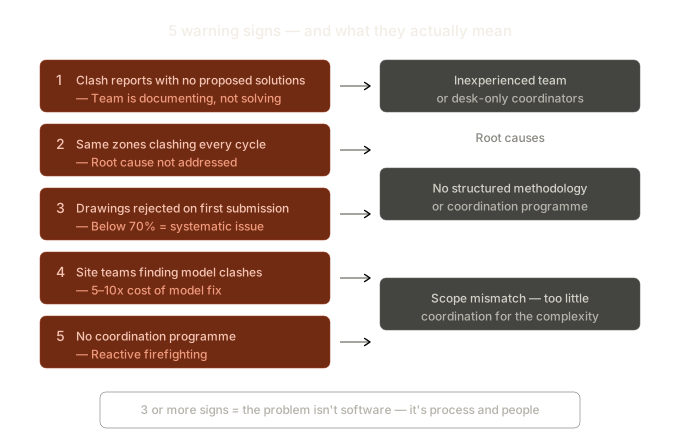
1. Clash Reports with Hundreds of Unresolved Items
A clash report should be a tool for decision-making, not a data dump. If your coordination team is sending you reports with hundreds of open clashes and no proposed solutions, they're passing the problem to you instead of solving it.
Effective coordination means reviewing each clash, classifying it by severity, and proposing a resolution. The project team's role is to approve or redirect — not to figure out how to reroute a duct that conflicts with a cable tray. If you're spending your coordination meetings working through raw clash lists rather than reviewing proposed solutions, the coordination process is backwards.
What good looks like: Every clash flagged comes with a proposed resolution and an impact assessment. The design team's role is approval, not problem-solving.
2. Repeated Clashes in the Same Zones
When the same area of the building keeps generating clashes across multiple coordination cycles, it typically means the root cause hasn't been addressed. Someone is fixing individual clash points without stepping back to resolve the underlying routing conflict.
This pattern is especially common when coordination is done by junior staff without site experience. They resolve the specific geometry the software flags without understanding that the real problem is a duct route that needs to shift two metres to clear the whole zone. Each cycle resolves five clashes and creates three new ones.
What good looks like: Root-cause analysis on clustered clashes. A single routing decision that eliminates 10–15 downstream conflicts, not whack-a-mole clash resolution.
3. Drawings That Get Rejected on First Submission
If your coordination deliverables regularly come back with significant comments or outright rejections, the coordination quality isn't where it needs to be. First-pass approval rates are a reliable indicator of coordination thoroughness.
On a well-coordinated project, the majority of drawings should achieve approval on first submission, with only minor comments on the remainder. According to NBS BIM survey data, the industry average for first-pass approval sits around 60–65%. If your rate is below that, something is systematically wrong. If it's above 80%, you've got a strong coordination team.
For reference: on a recent 32-storey project, we achieved an 85% first-pass approval rate across 337 construction drawings. That's not heroic — it's the natural outcome of coordinators who understand what the people reviewing those drawings need to see.
4. Site Teams Reporting Conflicts That Should Have Been Caught
This is the most expensive sign. When your installation team discovers spatial conflicts during construction that should have been visible in the model, the coordination process has failed at its primary purpose.
The usual causes are inadequate Level of Development in the model (systems modelled at LOD 200 when LOD 400 or 500 is needed for installation), incomplete model federation (not all disciplines included in the clash detection), or insufficient review of the clash results.
Every clash that reaches the site phase costs significantly more to resolve than it would have cost in the model. The labour, materials, programme impact, and management overhead of a site-based fix typically runs 5–10x the cost of a model-based resolution. On healthcare projects, that multiplier can reach 15x due to compliance consequences.
5. No Clear Coordination Programme or Milestones
If your coordination process doesn't have defined milestones — when each discipline model is due, when clash detection cycles run, when resolution proposals are reviewed, when drawings are submitted for approval — it's running reactively instead of proactively.
Reactive coordination means problems are addressed as they surface rather than prevented before they occur. It means the coordination team is always catching up, always responding to the latest crisis, and never getting ahead of the programme.
A clear coordination programme with defined inputs, outputs, and deadlines — aligned to ISO 19650 information management standards — transforms coordination from a firefighting exercise into a structured delivery process. If your coordination partner hasn't established this at the start of the project, ask why.
What to Do About It
If you recognise three or more of these patterns on your current project, the root cause is usually one of three things: insufficient experience on the coordination team, an inadequate methodology, or misalignment between the coordination scope and the project's actual complexity.
The solution isn't to add more technology or more software licences. It's to ensure the people doing the coordination understand both the software and the construction reality, and that the process is structured to catch problems early rather than document them late.
"An invaluable asset to any project team demanding expertise, precision, and successful delivery."
— Tony Joyce, Director of Engineering, Jones Engineering Group
Send us your current clash report and coordination programme. We'll review it and tell you where the gaps are — free, no obligation. If we can help, we'll propose a fixed-price coordination scope within 48 hours.
Frequently Asked Questions
What is the most common BIM coordination problem?
The most common problem is clash reports that document conflicts without proposing solutions. This shifts the problem-solving burden from the coordination team to the design and project management teams, consuming meeting time and slowing the programme.
What is a good first-pass drawing approval rate?
Industry average is approximately 60–65%. A well-coordinated project should achieve 75–85% or higher. Rates below 60% indicate systematic quality issues in the coordination process.
How much does poor BIM coordination cost?
Research by CIRIA estimates that coordination-related rework costs 5–8% of total project costs. On a £10M MEP package, that's £500,000–£800,000 in avoidable rework — compared to proper coordination costs of 1–3% of the package value.
Can you fix a coordination process that's already failing mid-project?
Yes. We've taken over coordination mid-project on several occasions. The typical pattern: we review the existing model, identify root-cause routing conflicts, resolve clustered clashes in priority order, and establish a structured programme going forward. On one recent project, we cleared a 400-item backlog in three weeks that the previous team had been working on for eight.