2D to 3D Coordination: The Cost-Benefit Analysis and Breakeven Point
The transition from 2D overlay coordination to 3D BIM coordination is an investment decision with a calculable breakeven point. Organisations that coordinate MEP services by overlaying 2D drawings from different disciplines — checking for conflicts visually on plotted sheets or in 2D CAD — achieve a functional level of coordination.
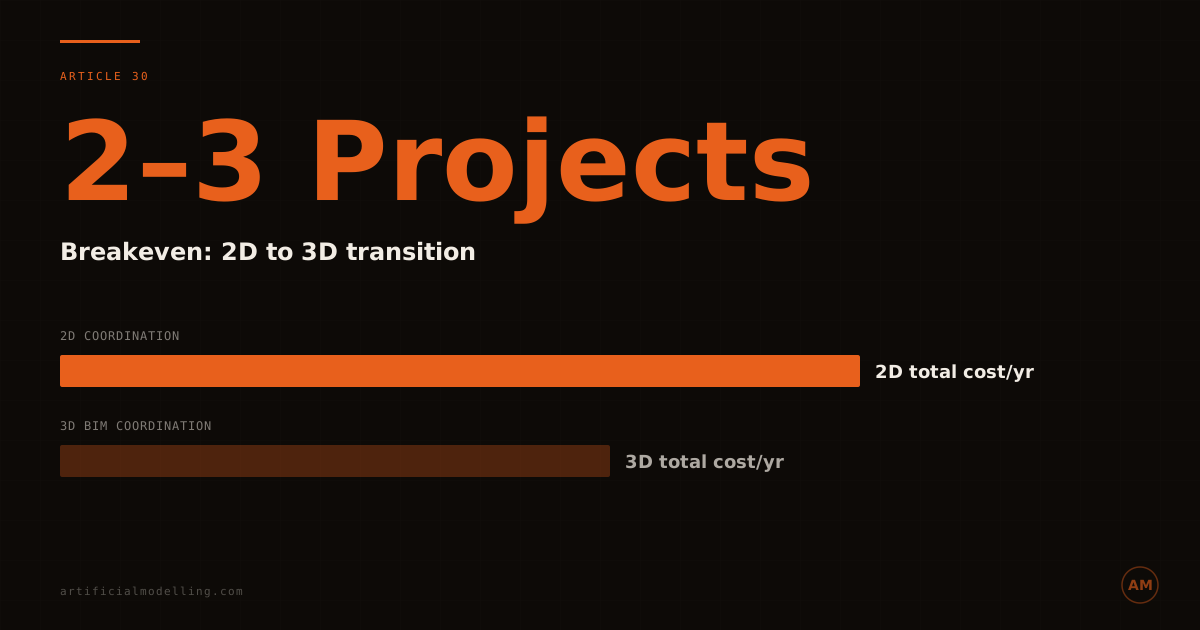
The transition from 2D overlay coordination to 3D BIM coordination is an investment decision with a calculable breakeven point. Organisations that coordinate MEP services by overlaying 2D drawings from different disciplines — checking for conflicts visually on plotted sheets or in 2D CAD — achieve a functional level of coordination. But the error rate is measurably higher than 3D coordination, and the rework cost difference defines the payback period.
2D coordination catches conflicts that are visible in plan view. It misses conflicts that are only visible in section or 3D view — vertical spatial conflicts, crossing services at different elevations, and equipment clearance violations. Industry experience indicates that 2D coordination misses 30–50% of the clashes that 3D coordination detects. Those missed clashes become site rework.
On a typical commercial project, the rework cost attributable to coordination deficiencies is €50,000–€150,000. 3D BIM coordination, which costs €40,000–€120,000 on the same project, prevents 70%+ of those deficiencies. The net saving is positive from the first project.
The Setup Cost
Transitioning from 2D to 3D coordination requires upfront investment in three areas:
Software licensing: Revit (€3,200/year), Navisworks Manage (€2,800/year), and potentially BIM 360/ACC for cloud collaboration (€2,000–€5,000/year). Total: €8,000–€11,000/year per seat.
Training: Competent 3D coordination requires Revit modelling proficiency, Navisworks clash detection skills, and federated model management capability. Training a 2D coordinator to 3D proficiency takes 3–6 months and costs €3,000–€8,000 in training plus productivity loss during the learning period.
Process development: Establishing coordination workflows, clash classification standards, report templates, and delivery procedures takes 40–80 hours of senior staff time — approximately €4,000–€8,000.
Total setup cost per coordinator: €15,000–€27,000 in the first year, reducing to €8,000–€11,000/year thereafter (software renewal only).
For an organisation running a coordination team of 2–3 people, the total first-year transition cost is €30,000–€81,000.
The Breakeven Calculation
The breakeven point depends on project volume and average project size. Here is the calculation for a mid-sized contractor running 4 projects per year:
| Factor | 2D Coordination | 3D BIM Coordination |
|---|---|---|
| Coordination cost per project | €15,000–€30,000 | €40,000–€80,000 |
| Rework from missed clashes per project | €50,000–€150,000 | €15,000–€45,000 |
| Total cost per project | €65,000–€180,000 | €55,000–€125,000 |
| Annual cost (4 projects) | €260,000–€720,000 | €220,000–€500,000 |
| First-year setup cost | €0 | €30,000–€81,000 |
| First-year total | €260,000–€720,000 | €250,000–€581,000 |
The breakeven point is reached within the first year for organisations running 3+ projects. For organisations running 1–2 projects per year, breakeven occurs in the second year.
FAQ
How long does the 2D to 3D transition take?
Training existing 2D coordinators to 3D proficiency takes 3–6 months. Establishing organisational processes and workflows takes an additional 2–3 months. Most organisations are fully operational in 3D coordination within 6–9 months of beginning the transition.
Is it cheaper to outsource 3D coordination than to transition in-house?
For organisations running fewer than 4 coordination projects per year, outsourcing to a specialist firm is typically more cost-effective than maintaining an in-house 3D coordination capability. The outsourced model eliminates setup costs, ongoing training investment, and software licensing overhead.
What rework reduction does 3D coordination achieve?
3D BIM coordination reduces coordination-related rework by 60–80% compared to 2D overlay coordination. The improvement comes from detecting vertical spatial conflicts, crossing-service clashes, and equipment clearance violations that 2D coordination cannot identify.
Artificial Modelling delivers 3D BIM coordination for clients transitioning from 2D workflows. Fixed-price. Immediate capability. Get started →